




The Financial Reporting Standard 102 (FRS 102) is central to how thousands of UK businesses prepare their accounts, and its most recent updates have prompted companies of all sizes to rethink the way they measure, present and interpret financial information. While changes to accounting standards can feel daunting at first glance, the latest revisions are ultimately designed to bring greater clarity, consistency and comparability to financial reporting.
In this article, we explore what’s changed, how businesses are responding and what areas you should pay particular attention to — including an accessible breakdown of the new approach to revenue recognition.
Understanding the Purpose Behind the Updates
The overarching aim of the FRS 102 changes is to align UK financial reporting more closely with international best practice while remaining proportionate for small and medium-sized entities. As businesses become increasingly interconnected and digital, stakeholders expect clearer information, more consistent measurement techniques and refined disclosures that reduce ambiguity.
The updates also reflect the evolving nature of transactions. Businesses now rely more heavily on intangible assets, subscription models, complex revenue streams and data-driven operations — all of which require more modern accounting treatment than traditional standards could offer.
Key Changes Businesses Are Paying Attention To
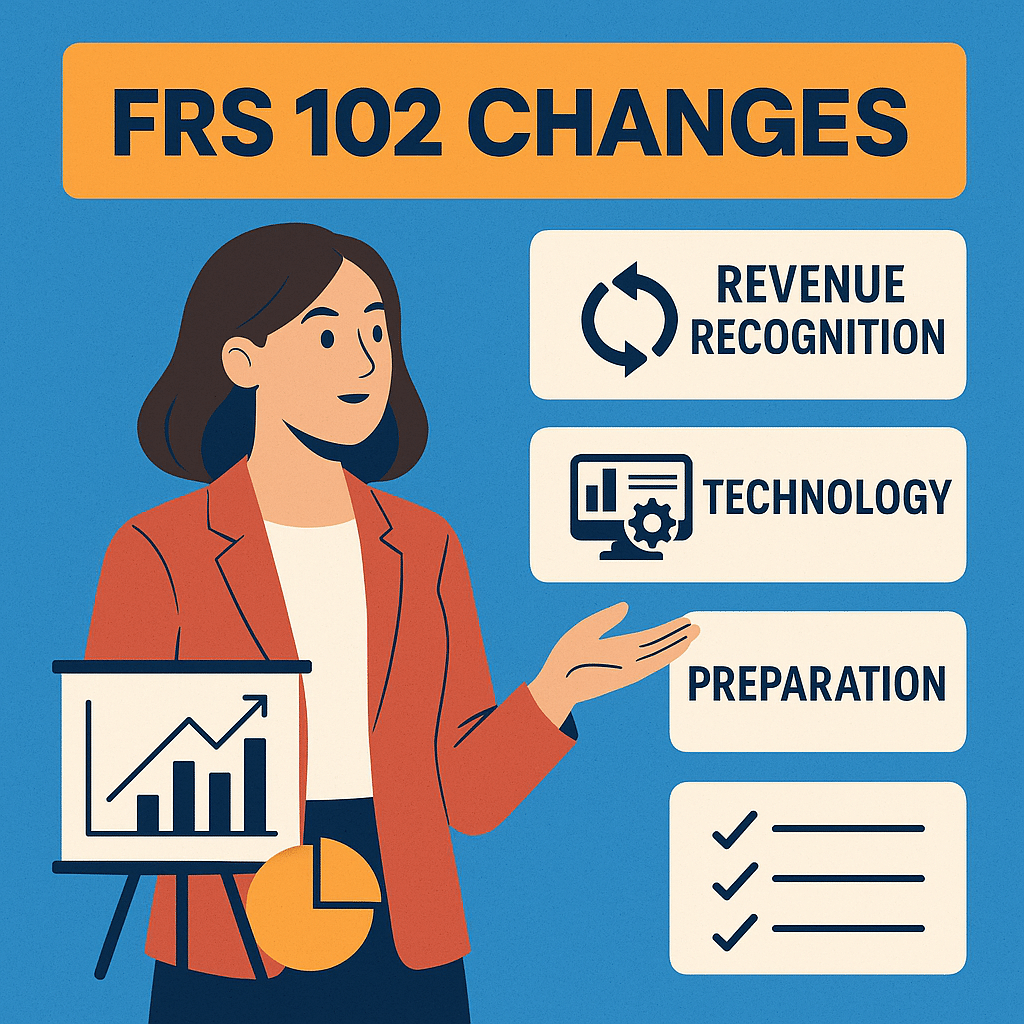
For many companies, the revisions mean they must re-evaluate how certain assets and liabilities are measured, how financial instruments are classified and how disclosures are presented. One of the most talked-about areas is the enhanced guidance on topics such as:
- Section 11 & 12: Financial instruments and how they are categorised
- Section 17: Property, plant and equipment, including updated valuation considerations
- Section 23: Revenue recognition
- Section 34: Specialised activities, including changes relevant to entities with service contracts
These updates don’t only affect accounting teams — they impact management decisions, investor communications and even system configurations. As a result, businesses across the UK are taking a proactive approach to understanding what the changes mean before implementation deadlines hit.
How Companies Are Preparing Internally
Businesses are recognising that adapting to the new FRS 102 framework means more than making a few tweaks to journal entries. Many finance teams are reassessing internal controls, recalibrating software tools and educating staff so the transition is smooth and compliant. This preparation often includes reviewing policies, updating documentation and engaging auditors earlier than usual to flag potential issues.
For SMEs in particular, the shift has highlighted the importance of clear processes. Companies that previously relied on year-end adjustments or manual workarounds are now formalising their internal systems to ensure ongoing compliance. This change not only avoids issues later but also makes everyday financial management far easier.
Revenue Recognition: A New Level of Clarity
One of the most significant areas touched by the FRS 102 updates is FRS 102 revenue recognition. Historically, many businesses operated under simplified assumptions about when revenue should be recorded, leading to inconsistencies across sectors and business models. The updated guidance encourages companies to follow a clearer, more structured approach that reflects when value is genuinely delivered to customers.
Under the revised rules, businesses need to consider whether revenue should be recognised at a single point in time or spread across a contract’s duration. Subscription-based companies, construction firms, companies offering bundled services and businesses with staged delivery models are all finding themselves re-evaluating when income is truly “earned.”
This isn’t merely a technical change — it affects cash flow forecasting, performance metrics and management reporting. Companies now need to align their operational processes, billing systems and contract terms with the new recognition principles to ensure that financial statements reflect economic reality, not outdated assumptions.
Technology’s Role in Streamlining Compliance
Accounting software providers have begun updating their systems to accommodate the latest changes, and businesses are taking full advantage. Automating calculations, depreciation schedules, financial-instrument classifications and contract-based revenue models reduces the likelihood of human error and significantly speeds up month-end and year-end processes.
Companies that embrace modern systems are discovering that automation doesn’t just solve compliance problems — it provides more accurate real-time insight into performance. This is particularly important as the updates require a greater level of precision and consistency across financial reporting.
Common Challenges Businesses Are Facing
The transition hasn’t been entirely straightforward, and many companies are encountering similar hurdles. These include difficulties interpreting new revenue rules, challenges training staff and confusion over how to classify certain instruments or assets. Some businesses are finding that their existing software isn’t fully compatible, leading to temporary manual solutions until updates are rolled out.
To address these issues, companies are investing in training programmes, seeking professional advice and refining internal processes. The biggest lesson so far? Early preparation pays off. Businesses that took a proactive approach are adapting with far fewer disruptions.
Practical Steps Companies Are Taking to Stay Ahead
One of the most encouraging trends is how proactive UK businesses have been in embracing these updates. Many are implementing steps such as:
- Reviewing accounting policies for accuracy and alignment with the new guidance
- Updating internal financial procedures and documentation
- Conducting impact assessments on revenue streams and financial instruments
- Training finance teams to understand and apply revised principles
- Engaging auditors earlier to identify potential compliance risks
This structured approach is helping companies tackle the transition with confidence rather than uncertainty.
The Wider Business Impact of the Updates
FRS 102 isn’t just an accounting exercise — it influences the bigger picture. Lenders, investors and stakeholders rely on transparent, consistent and comparable financial statements. By adopting these changes, businesses enhance their credibility, improve decision-making and strengthen financial governance.
Many business leaders also report that the process of adapting to the update has encouraged them to rethink efficiency, automate more processes and approach financial management more strategically. In some cases, the standard has prompted broader operational improvements, from contract structuring to internal reporting cycles.
Final Thoughts: Adaptation Is an Opportunity, Not an Obligation
The latest FRS 102 changes bring a fresh level of clarity to UK financial reporting, and while they may require some adjustment, they offer businesses an opportunity to modernise their systems, refine their reporting and improve their financial insight. By taking a thoughtful, proactive approach, companies can ensure compliance while setting themselves up for smoother audits, stronger governance and more reliable information for decision-making.
Whether you’re a small company or a growing enterprise, understanding the changes now ensures you stay ahead — and gives your business the clarity it needs to thrive in an increasingly complex financial world.