


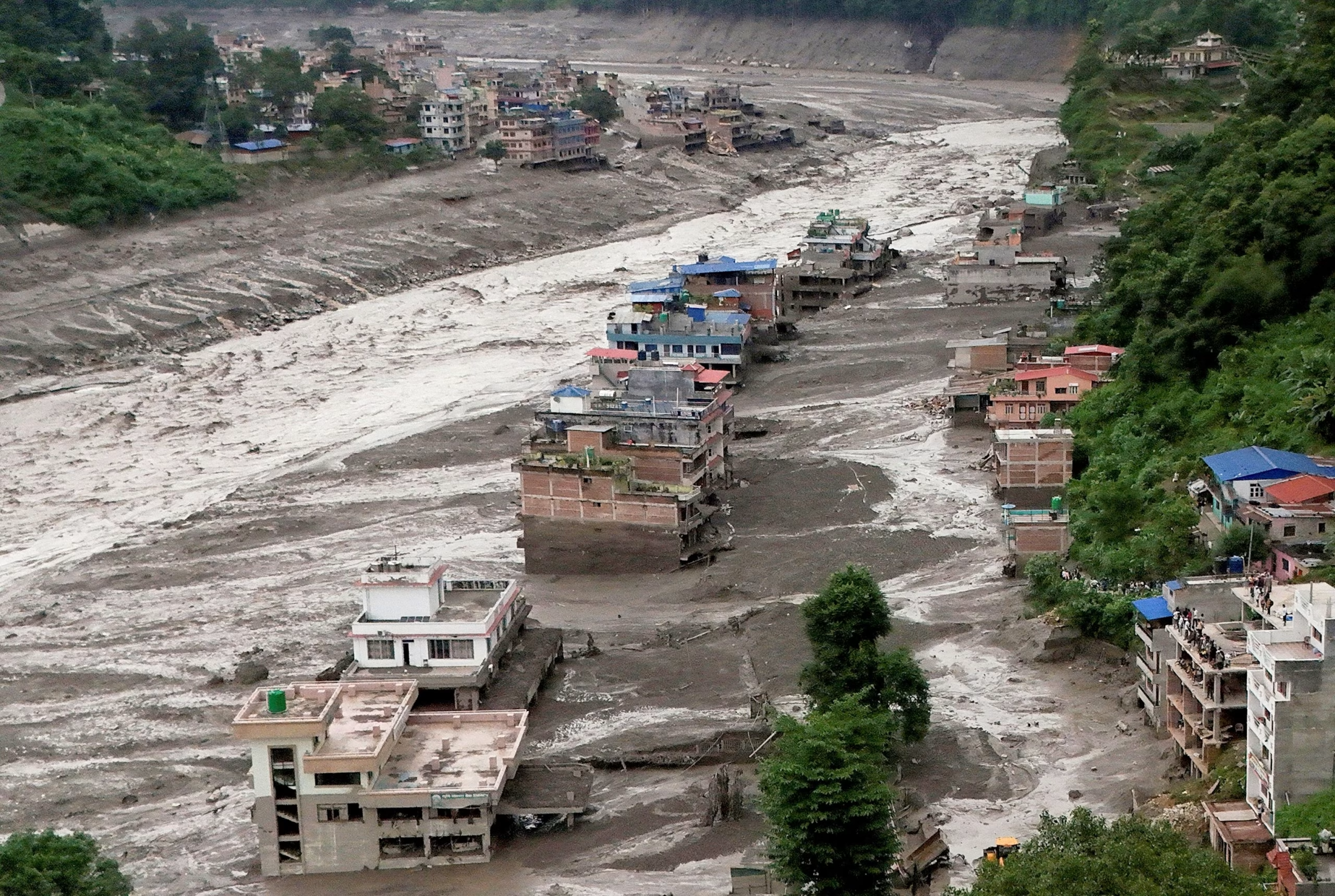

Nepal’s devastating flash floods have killed at least 469 people, while 977 remain unaccounted for, as rescuers face a fresh threat from an overflowing lake formed after the disaster.
The catastrophe struck on 26 August along the Nepal-China border, sending water, mud, rock and debris through the Bhote Koshi and Trishuli river systems. At least 3,253 people have been rescued in Nepal, but the operation has been complicated by destroyed roads, bridges and other infrastructure.
The latest development is the emergence of a secondary flood risk. A barrier lake formed by debris near the border has begun overflowing, prompting authorities to temporarily halt some rescue activity while they assess the danger.
The disaster also has a direct UK dimension. Around 33 British nationals are reported to be among those missing, while the UK has offered £5 million in support and emergency responders to Nepal.
Table of Contents
- Key Facts
- Latest Developments
- What happened in Nepal?
- Why has the rescue operation been halted?
- British nationals missing
- UK response to the Nepal floods
- Rescue operation
- What caused the flash flood?
- Why this matters
- Impact on UK readers
- Expert analysis
- Future outlook
- Key Takeaways
- FAQs
- Conclusion
Key Facts
| Detail | Latest confirmed information |
|---|---|
| Date of disaster | 26 August 2026 |
| Deaths in Nepal | 469 |
| People unaccounted for in Nepal | 977 |
| Foreign nationals unaccounted for in Nepal | 517 |
| People rescued | 3,253 |
| Rescue helicopters | 15 |
| British nationals reported missing | Around 33 |
| Main affected river systems | Bhote Koshi and Trishuli |
| Latest threat | Overflowing barrier lake |
| UK assistance offered | £5 million |
Figures are changing as search teams identify victims and reconcile missing-person reports.
Latest Developments
The most urgent development on Friday is the threat of further flooding.
A lake formed by debris following the initial disaster has begun overflowing. Authorities temporarily stopped rescue operations while assessing whether rising water could produce another dangerous surge downstream. Reuters reported that rescue operations were suspended for at least 90 minutes as the situation was assessed.
The development is particularly dangerous because many communities and rescue routes have already been damaged.
Roads, bridges, communications infrastructure and power facilities have been affected, leaving some areas difficult to reach by conventional ground transport.
Chinese authorities have also paused rescue activity in the worst-hit area of Tibet because of the risk associated with the overflowing lake.
What happened in Nepal?
The disaster began on 26 August near the Nepal-China border.
A powerful ice-and-rock event caused a massive flow of water and debris to enter the Lhende Khola before moving into the Bhote Koshi and Trishuli river systems.
The precise chain of events remains under investigation, but preliminary assessments point towards a glacial or ice-rock avalanche and associated landslide rather than a conventional rainfall-driven flood.
The World Meteorological Organization said preliminary reports indicated an avalanche of ice and rocks in Tibet near the Nepal border triggered the devastating flooding.
The resulting torrent travelled through populated areas and damaged homes, bridges, roads, hydropower infrastructure and border facilities.
Why has the rescue operation been halted?
The rescue operation has not simply stopped because of a lack of personnel.
The immediate problem is responder safety.
The initial flood created large quantities of debris, while the same debris has contributed to the formation of unstable water bodies. An overflowing lake could release another surge into areas where rescuers and survivors are already operating.
Authorities therefore have to balance two competing priorities:
- finding people who may still be alive;
- avoiding exposing rescuers and survivors to another sudden flood.
The risk has forced temporary pauses in some operations while water levels and the stability of the lake are assessed.
British nationals missing
The disaster has caused particular concern in the UK because British citizens were travelling through the affected region.
Around 33 British nationals have been reported missing or unaccounted for. Reports indicate that some were travelling in connection with pilgrimage and tourism routes towards the Himalayan region.
The figure should be treated as a developing consular number rather than a final death toll. People can remain uncontactable because communications and transport infrastructure have been severely disrupted.
The UK Government has urged British nationals in the region to follow instructions from local authorities and keep up with official travel advice.
UK response to the Nepal floods
The UK has offered £5 million to support Nepal’s response.
The government has also offered emergency responders and increased consular support for British nationals affected by the disaster.
The Prime Minister’s Office said the UK was in contact with relevant authorities and would support British nationals affected by the disaster.
For British citizens directly affected by the emergency, GOV.UK lists the following assistance numbers:
- From Nepal: +977 (0)14237100
- From the UK: +44 (0)207 008 5000.
Rescue operation
Nepal’s response has involved the country’s army, police, armed police and helicopter operators.
The latest figures cited from NDRRMA show:
- 3,253 people rescued
- 15 helicopters deployed
- 517 foreign nationals among those still unaccounted for
- 977 people unaccounted for in Nepal.
The scale of the operation reflects the geographical difficulty of the disaster.
The flood travelled through mountainous river corridors where access is already difficult even in normal conditions. Damage to roads and bridges has made ground-based rescue and relief considerably harder.
Helicopters have therefore become an important part of the response.
What caused the flash flood?
The precise scientific sequence is still being investigated.
Preliminary evidence points towards a major ice-and-rock avalanche or glacial collapse near the Nepal-China border.
The event sent huge quantities of ice, rock, mud and water into the river system.
Scientists and monitoring agencies are continuing to examine seismic and satellite data to establish exactly how the event unfolded.
That distinction matters because early reports about earthquakes and other possible triggers circulated while the scale of the disaster was still becoming clear.
The World Meteorological Organization has described the avalanche explanation as a preliminary assessment rather than a final scientific conclusion.
Why this matters
This is not simply a local flooding incident.
The disaster demonstrates how a high-altitude geological event can rapidly become a cross-border humanitarian crisis.
The affected region contains:
- international travel routes;
- pilgrimage routes;
- hydropower infrastructure;
- roads and bridges;
- border facilities;
- remote communities.
The destruction of transport links also means that the consequences extend beyond the places directly hit by the first wave.
Impact on UK readers
British travellers
Anyone currently travelling in affected parts of Nepal should follow local instructions and the latest GOV.UK travel advice.
The Foreign, Commonwealth & Development Office says the 26 August flooding caused widespread damage in Rasuwa and along the Nepal-China border. Roads, buildings, transport and communications infrastructure have been severely damaged.
Families in the UK
Families concerned about British nationals should use official consular channels rather than relying on unverified social media posts.
The situation is changing quickly and missing-person lists can change as communications are restored and individuals are located.
Travel companies
Tour operators and trekking companies operating in affected areas face significant disruption.
The UK Government advises travellers to remain alert to changing conditions and to check with their travel providers and insurers where journeys are affected.
The Nepalese community in Britain
The disaster also matters to Britain’s Nepalese communities, many of whom have family, friends or professional connections in the affected areas.
Local authorities in Britain have already issued statements expressing solidarity with Nepalese communities and directing people towards official UK travel advice.
Expert Analysis
The immediate challenge is the interaction between the original flood and the new water body created by debris.
In a conventional flood, emergency teams can focus primarily on the water that has already moved downstream.
Here, the landscape itself has been altered.
A debris blockage can create a temporary lake. If that lake becomes unstable, water can accumulate and then move suddenly downstream, creating a second hazard for communities that may already have lost evacuation routes.
This is why the latest development is not simply another update to the casualty figures. It changes the operating conditions for the rescue effort.
The Department of Hydrology and Meteorology continues to provide real-time hydrological monitoring and flood-warning information, highlighting the importance of ongoing water-level surveillance.
Future Outlook
The next phase will depend heavily on the stability of the newly formed lake and conditions along the affected river corridors.
Authorities will need to:
- monitor water levels;
- assess unstable slopes and debris dams;
- identify safe routes for rescuers;
- continue aerial searches where conditions permit;
- restore communications;
- establish reliable lists of missing people;
- deliver food, water and medical assistance;
- assess damaged roads and bridges.
For families waiting for news of missing relatives, the process is likely to remain uncertain while authorities reconcile reports from different districts and countries.
The casualty and missing-person numbers should therefore be expected to change.
Key Takeaways
- Nepal’s flash flood disaster began on 26 August 2026.
- Nepal has reported 469 deaths.
- 977 people remain unaccounted for in Nepal.
- 517 foreign nationals are among those unaccounted for.
- More than 3,200 people have been rescued.
- Around 33 British nationals are reported missing.
- The UK has offered £5 million and emergency-response assistance.
- A newly formed barrier lake has begun overflowing.
- The lake has created a fresh threat to rescuers and communities.
- Authorities are continuing to monitor the situation and adjust rescue operations accordingly.
FAQs
How many people have died in the Nepal floods?
Nepalese authorities reported 469 deaths by 28 August 2026. China has separately reported three deaths in Tibet.
How many people are missing in Nepal?
Nepal’s latest reported figure is 977 people unaccounted for. International reporting puts the combined Nepal-China figure above 1,500 when the figures from both sides of the border are included.
Are British nationals missing in Nepal?
Yes. Around 33 British nationals are reported to be among those missing or unaccounted for.
Why did the Nepal flash flood happen?
Preliminary assessments indicate that an ice-and-rock avalanche or glacial collapse near the Nepal-China border triggered a massive debris flow into the river system. The precise sequence remains under investigation.
Why was the Nepal rescue operation suspended?
Some rescue activity was temporarily suspended after a debris-dammed lake began overflowing, creating fears of another flood surge and making conditions unsafe for rescuers.
How many people have been rescued?
The latest NDRRMA figures cited by Nepalese reporting indicate that 3,253 people have been rescued.
What is the UK doing to help Nepal?
The UK has offered £5 million, emergency responders and additional consular support for British nationals affected by the disaster.
Is it safe for British tourists to travel to Nepal?
The situation in the affected areas is highly unstable. GOV.UK advises travellers to follow local authorities and monitor its Nepal travel advice because conditions can change rapidly.
How can British nationals affected by the floods get help?
GOV.UK lists +977 (0)14237100 for people calling from Nepal and +44 (0)207 008 5000 for callers in the UK.
Is another flood possible?
Authorities have warned of further flooding because a debris-formed lake has begun overflowing. Rescue teams have temporarily withdrawn from some areas while the risk is assessed.
Conclusion
Nepal’s flash flood disaster has entered a dangerous new phase.
The immediate search for survivors is continuing after 469 deaths were recorded in Nepal, but the formation and subsequent overflow of a debris-dammed lake has created a new threat to communities and rescue workers.
For UK readers, the crisis has an additional dimension: around 33 British nationals are reported missing, while the UK government has offered £5 million and emergency support.
The situation remains fluid. Figures are likely to change as search teams reach more isolated areas, communications improve and authorities reconcile missing-person reports.
Tamar Bridge will update this story as verified information becomes available.